The Newark Sermon
City of GodThe Newark Sermon is the single most consequential act of public speech in the career of Thomas Pemberton, the Episcopal priest known throughout the novel as Pem. It is the sermon that Pem himself believed may have been the "last straw" for his bishop, the moment when his long-simmering theological dissent finally became an open challenge to the church's self-understanding. Delivered not at his own St. Timothy's Episcopal Church but as a guest stint in Newark, in a diocese Pem described as "broad church" — welcoming women, gays, and the liberal side of the argument — the sermon asked a question that would haunt the rest of his life: what had the engineered slaughter of the Jews in Europe done to Christianity, to the Christian story of Christ Jesus? It was, by Pem's own admission, "the doozy."
The Question at the Heart of the Sermon
The sermon's provocation was deceptively simple. Pem asked his congregation to consider whether the Holocaust was a problem only for Jewish theologians, given what he called the "meager response" of Christians to the catastrophe. He framed this not as an accusation but as an inquiry into the adequacy of Christian practice. What mortification, what ritual, what practice might have been a commensurate Christian response to the disaster? He wanted something that would assure the faithful that their religion was not "some sort of self-deluding complacency," something that would assure them of "the holy truth of our story." He demanded a response "as earthshaking in its way as Auschwitz and Dachau." The scale of his imagined remedies matched the scale of the crime: a mass exile, a lifelong commitment of millions of Christians to wandering, derelict, over the world, a clearing out of the lands and cities a thousand miles in every direction from each and every death camp. He told the congregation he did not know what the proper response would be, but he was sure he would recognize it if he saw it.
The Crowd and the Context
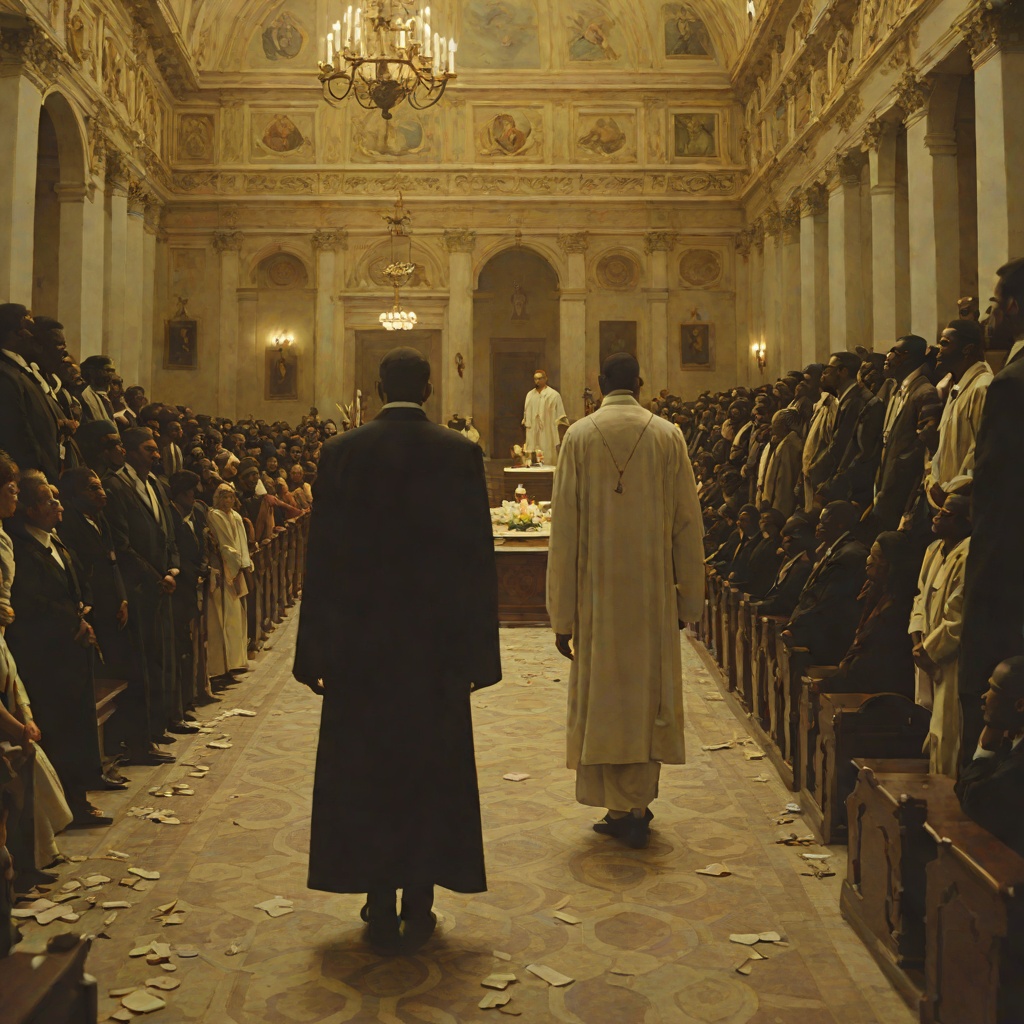
The sermon was delivered to a big crowd that morning, and Pem could feel that they were with him. After the empty pews of St. Timothy's, the Newark congregation seemed to him like Radio City. The contrast was not lost on him: the packed house in Newark stood against the hollow silence of his own church, where the theft of the brass cross had left a shadow of the crucifix in the unfaded paint of his predecessor's poor taste. The sermon was thus delivered from a position of institutional weakness — a priest whose own congregation had dwindled, whose church had been violated — yet it found its largest audience in a borrowed pulpit. The energy of that crowd, the sense of being heard, may have emboldened Pem to push his questions further than he otherwise would have.
The Bishop's Last Straw
Pem himself was uncertain whether the Newark Sermon was the actual cause of the bishop's displeasure. When pressed, he said it "could have been" the guest stint that the bishop felt was the last straw, but he was not sure. He insisted that the matter was not simple, that it was "a bunch of things," and that the church had more leeway for people like him than his interlocutor gave it credit for. The sermon's content, however, was unmistakably the kind of thing that would draw ecclesiastical attention. By asking what a commensurate Christian response to the Holocaust might be, Pem was implicitly indicting the church's actual response as inadequate, and by extension questioning whether the Christian story itself could survive the encounter with genocide. This was not a doctrinal quibble but a challenge to the very foundations of Christian self-understanding, delivered before a large and receptive audience.
The Sermon's Place in Pem's Larger Crisis
The Newark Sermon did not stand alone. It was the public face of a private crisis that had been building for years. Pem had already been moved to longing by the sight of "good and righteous folk praying at the bedside of their minister," their faith glowing like light around them, and had asked himself whether faith must be blind, whether it must come of people's need to believe. The sermon was his attempt to answer that question publicly, to find a faith that could survive rational scrutiny. It also connected directly to his theft of the St. Timothy's cross and its placement on the roof of the Synagogue of Evolutionary Judaism. The cross, which he had found lying flat on the black tarred roof of the synagogue, its transverse exactly parallel to the front of the building, its upright pressed against the granite pediment, was the physical embodiment of his question: what did the central symbol of Christianity mean after the Holocaust? The sermon asked the question in words; the cross asked it in brass.
The Wedding Prayer as the Sermon's Fulfillment
The concerns of the Newark Sermon found their final expression in Pem's wedding prayer, delivered as his "final act as a Christian and an ex–Christian priest." Speaking to God in "one of our intonative systems of clicks and grunts, glottal stops and trills," Pem returned to the same themes: the monstrously evil mortifiers of humanity, the enslavement and horrible death of tens of millions, the exponential murder of souls, the masses of the violently dead consigned to anonymous oblivion. He declared that the dead "are not resurrectable, they cannot and will not resurrect even in the imagination of your Christian faithful." He told God that the genocidal cruelties of the age had brought Him into disrepute, that even among those clinging to a love of God there was a risen suspicion that God was "part of the problem," bought and embraced "like the lowest, most pathetic streetwalker." The wedding prayer was the Newark Sermon's conclusion: the question posed in Newark found its answer not in any Christian ritual but in Pem's abandonment of Christianity itself.
The Sermon's Significance
The Newark Sermon is the intellectual hinge of Pem's entire trajectory. It is the moment his private doubts became public doctrine, the moment he committed himself to a question he could not answer within the framework of his own faith. The sermon's demand for a "commensurate" Christian response to the Holocaust was, in effect, a demand that Christianity either transform itself beyond recognition or admit its failure. Pem's own answer — the theft of the cross, the deconsecration of St. Timothy's, his conversion to Judaism — was the recognition that no such response was forthcoming. The sermon thus stands as both indictment and prophecy: it names the problem that the rest of Pem's life was spent trying to solve, and it foreshadows the solution he would eventually find outside the church entirely.